
Damp & Mould Removal in Liverpool’s Rented Homes: Scrubbed With Love Analyses Five Years of Council Data
*Collaborative Post
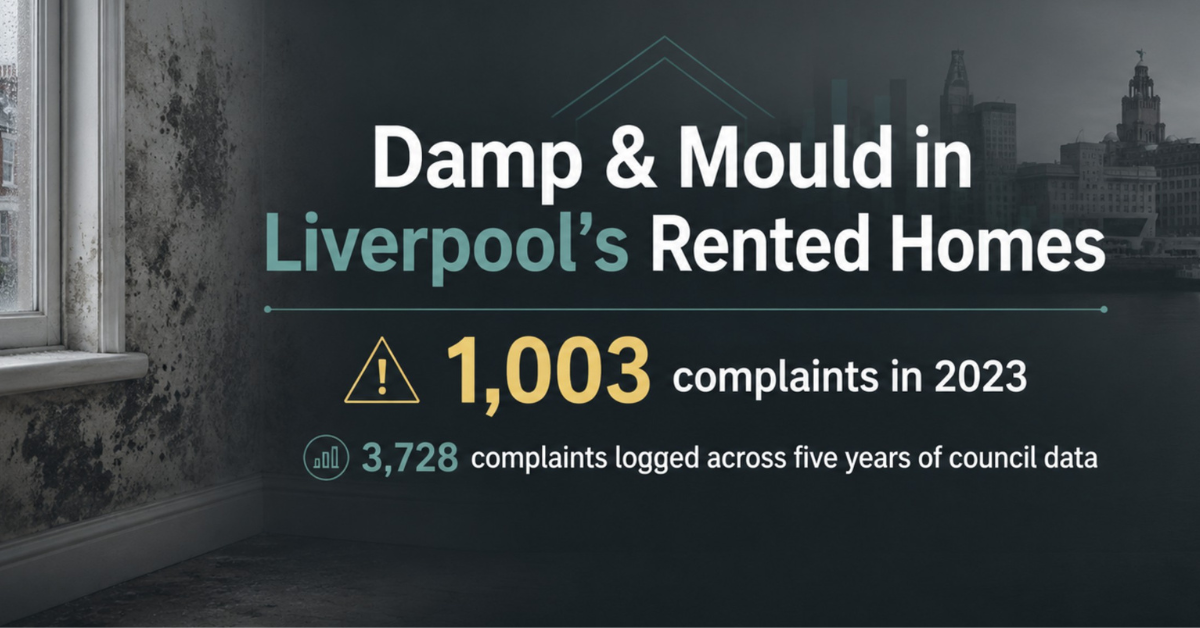
Liverpool City Council received 1,003 complaints about damp and mould in private rented housing in 2023, nearly double the 524 logged the year before. That figure comes from a Freedom of Information request submitted to Liverpool Council and covers the five most recent calendar years available, giving one of the clearest pictures yet of how widespread the mould problem has become in the city’s private rented sector.
The data was obtained and analysed by Scrubbed With Love, a Merseyside cleaning company that has been operating in Liverpool and the wider North West since 2019, and whose work includes mould removal as one of its specialist services alongside biohazard and trauma cleaning. Founder and director Josie Cookson requested the figures to better understand demand patterns in the region, but what came back told a wider story about the condition of rented housing in the city.
What the council’s complaint figures actually show
The full damp and mould figures run as follows. There were 524 complaints in 2022, rising sharply to 1,003 in 2023. The number eased slightly to 926 in 2024 and 833 in 2025, before standing at 442 for the year to date in 2026, a partial figure rather than a full annual total. Across the five years the council has logged 3,728 complaints in total, an average of more than 14 a week even in the quieter years.
The near doubling between 2022 and 2023 stands out as the single biggest shift in the data, and it is worth asking what changed in that period. Energy prices rose sharply through late 2022, and there is a well established link between higher heating costs, reduced ventilation, and condensation issues, since tenants often respond to expensive heating bills by keeping windows closed and extractor fans switched off, which allows moisture buildup and excess moisture to collect on cold surfaces. That is not the only possible explanation, but it lines up with the timing closely enough to be worth flagging.
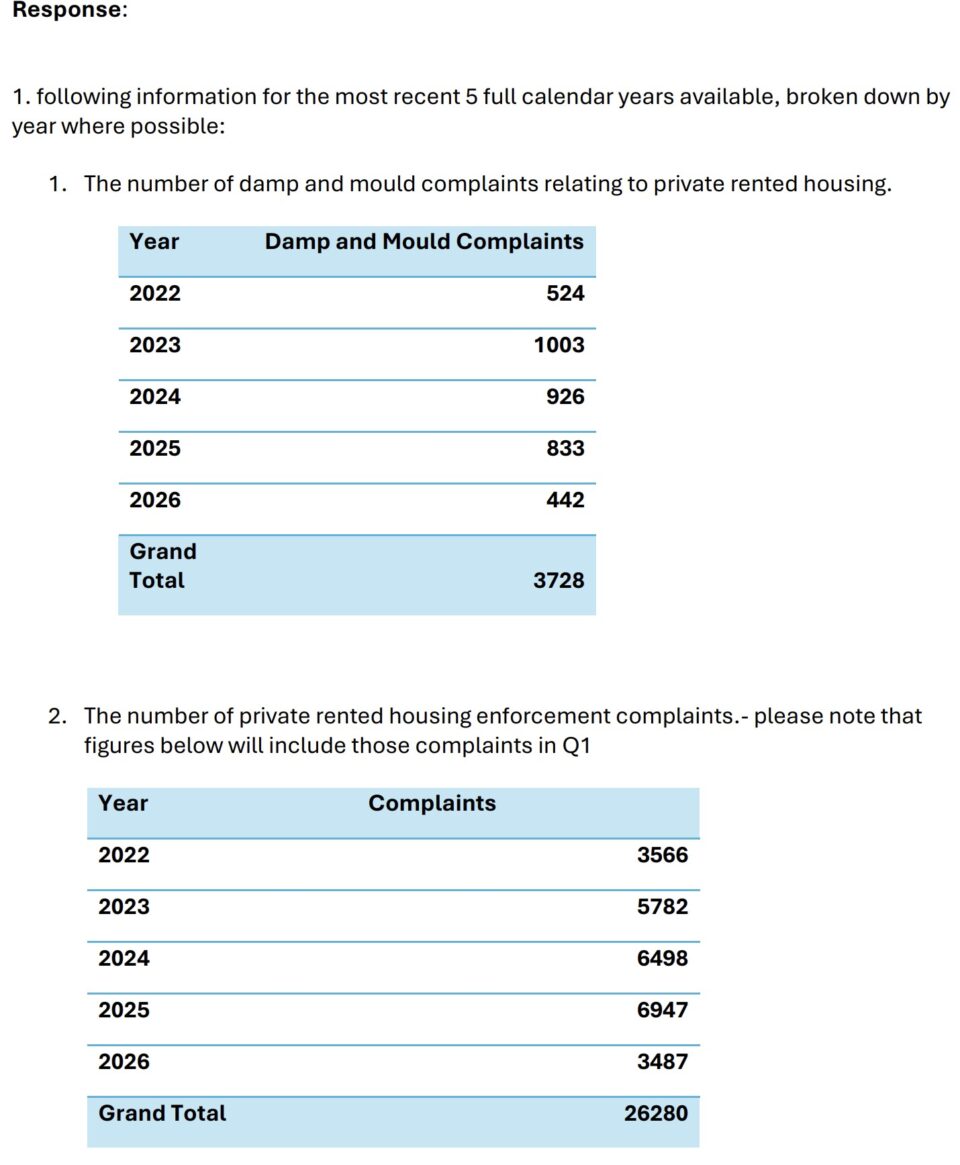
Alongside the mould figures, the same FOI request returned data on private rented housing enforcement complaints more broadly. These rose from 3,566 in 2022 to 5,782 in 2023, 6,498 in 2024 and 6,947 in 2025, before reaching 3,487 for the year to date in 2026, bringing the five year total to 26,280. Enforcement complaints cover a wider range of issues than damp and mould alone, but the steady year on year increase across the same period suggests the rented housing stock in Liverpool is under sustained and growing pressure, not just on this one issue.
The wider picture: tighter rules are coming for landlords
This data lands against a backdrop of significant regulatory change. Awaab’s Law, named after two year old Awaab Ishak who died in 2020 following prolonged exposure to mould in his family’s social housing flat, came into force for social landlords in England on 27 October 2025. It introduces strict legal timeframes within which landlords must investigate and resolve serious damp and mould hazards once they are reported, treating them as health risks rather than routine maintenance.
The Renters’ Rights Act, which also received Royal Assent in October 2025, commits to extending equivalent duties to the private rented sector, meaning private landlords are expected to eventually face the same fixed timescales for investigating and fixing mould problems. The exact timetable for that extension is still subject to consultation rather than confirmed, but the direction of travel is clear, and councils are already being given stronger investigatory powers to inspect properties and access landlord records. For a city with Liverpool’s volume of complaints, that shift in enforcement could mean considerably more scrutiny on the private rented sector in the next few years.
Why older Liverpool properties are particularly exposed
A large share of Liverpool’s private rented stock is older terraced and Victorian housing, much of which was never built with modern ventilation in mind. Several recurring issues come up again and again on mould removal jobs across the city. Poor ventilation is the most common, often combined with extractor fans that are missing, broken or simply unused. Rising damp and penetrating damp both allow moisture to enter through walls and floors, particularly in properties with ageing or absent damp proofing. Leaking pipes and other hidden leaks behind walls or under flooring can go unnoticed for months, feeding persistent damp and structural damp long before any visible mould appears on a surface. Poor insulation compounds all of this, since cold surfaces encourage condensation and give airborne mould spores the conditions they need to settle and spread.
The health risks behind the numbers
What turns this from a property maintenance issue into a public health one is the documented link between mould exposure and health symptoms. Prolonged exposure to mould spores has been associated with respiratory problems, allergic reactions, skin irritation and nasal congestion, with children, older people and anyone with an existing respiratory condition or weakened immune system at greater risk. Indoor air quality in a home with an active mould problem can be measurably worse than in one without, even where the mould itself is confined to a small, visible patch. This is precisely the link that drove the introduction of Awaab’s Law in the first place, and it is the reason councils increasingly treat damp and mould complaints from private tenants as a safeguarding matter rather than a cosmetic one.
How a professional mould removal job actually works
Josie Cookson, founder of Scrubbed With Love, said the rise in complaints reflects what her team sees on the ground in Liverpool. A proper mould removal service does not simply clean visible black mould off a wall and leave, since that approach almost always sees the problem return within weeks. Cookson explained that a thorough job starts with a moisture assessment using moisture meters to identify the root cause, whether that is poor ventilation, a hidden leak, or rising damp, because treating the surface without addressing the underlying moisture source rarely solves the problem long term. Her team uses full personal protective equipment and follows strict safety protocols throughout, since disturbing mould growth can release airborne spores that pose health risks to anyone in the property if the work is not contained properly. Scrubbed With Love is fully insured and operates as a licensed waste carrier, which matters for the safe removal and disposal of contaminated materials during a mould job, and the company holds a 4.9 out of 5 rating from 62 reviews on Google.
Warning signs and getting professional help
A persistent musty smell is often the first sign of a mould issue, sometimes appearing before any mould growth is actually visible. Dark patches on walls or ceilings, particularly around windows, in corners, or behind furniture pushed against external walls, usually point to a damp problem that has been building on cold surfaces and other damp surfaces nearby. Water droplets forming on cold spots, especially in bathrooms and kitchens after cooking or showering, are a sign that ventilation is inadequate for the moisture produced by everyday tasks around the home. High humidity across a whole property, rather than in one isolated room, often points to water leaks or hidden leaks rather than simple condensation, and this should prompt a professional assessment rather than a quick wipe down with anti mould paint, which only masks the surfaces affected without resolving the moisture issues underneath.
Anyone noticing these signs in a Liverpool rental, commercial property or any other affected area should act quickly rather than waiting for the problem to spread, since a small patch dealt with early is a far smaller job than an established mould infestation later on. Specialist treatments and a proper mould removal process, carried out by a mould removal specialist with the right equipment and safety protocols, address the root cause rather than the surface symptom. Scrubbed With Love offers professional mould removal, mould remediation and mould treatment across Liverpool and Merseyside, working with tenants, landlords and commercial clients to identify the source of a damp issue, carry out mould control with minimal disruption to the property, and confirm the affected area has been properly treated before the job is signed off.
What this means for Liverpool
With private rented housing enforcement complaints having nearly doubled over five years and damp and mould complaints following a similar pattern, the data points to a private rented sector in Liverpool that is under real strain. As regulatory pressure on landlords increases nationally, tenants are likely to become more confident about reporting problems, and councils more active in following them up. For landlords, that makes early professional intervention considerably more sensible than waiting for a complaint to escalate into formal enforcement action.
Scrubbed With Love provides mould removal services across Liverpool and the wider Merseyside area, alongside its core specialism in biohazard and trauma cleaning. More information on the company’s mould removal service is available on its Liverpool service page.
*This is a collaborative post. For further information please refer to my disclosure page.
Related Posts:
The 3 Essentials To Improve Your Smile

Our smiles are essentially formed when we are kind after our first dentist visits and our adult teeth grow in. Read more
Sydney’s Top 5 Best Disability Care Companies

For your loved ones who need extra support, choosing the right disability care provider is one of the most important Read more
How to Use LinkedIn to land Your Dream Job

LinkedIn is one of the most used popular professional networking platforms of the 21st century. According to the company officials, Read more
6 Ways to Keep Your Liver Healthy

The largest solid organ in the human body, the liver is responsible for carrying out a lot of functions that Read more