

What Is the Breeze App? An App That Makes Self-Discovery Effortless
*Collaborative Post
Understanding your emotions is not always easy, especially when stress makes self-reflection feel like another task on your to-do list. The Breeze Wellbeing app is one of many digital tools designed to make this process more affordable for your mental batteries.
What Is the Breeze App?
The Breeze app is a self-discovery app designed to boost awareness by better exploring your habits, behavior, past, and neurology. It consists of self-reflection tools and short daily activities that support emotional awareness and manageable self-care routines.
Breeze Wellbeing has been on the market for six years, having been launched in 2020. According to the official website, https://breeze-wellbeing.com/, the app is built around four guiding principles:
- Empathy-driven design
- Continuous effort
- Clarity over complexity
- Science-backed insights, drawing on established psychological knowledge while remaining educational rather than diagnostic.
6 years later, Breeze Mental Health has already had over 17+ million downloads. Out of them, 100,000 became part of the Breeze community, self-aware individuals who want to be kinder to themselves.
Features of the Breeze Mental Health App
The Breeze Mental Health app has 7 primary features:
- Quizzes
- Journaling
- Mood tracker & analytics
- Mindfulness games
- Affirmations
- Insights
- Routines
The app’s flexibility stems not only from the variety of features but also from their universality: certain tools are multipurpose. More about it below.
Quizzes
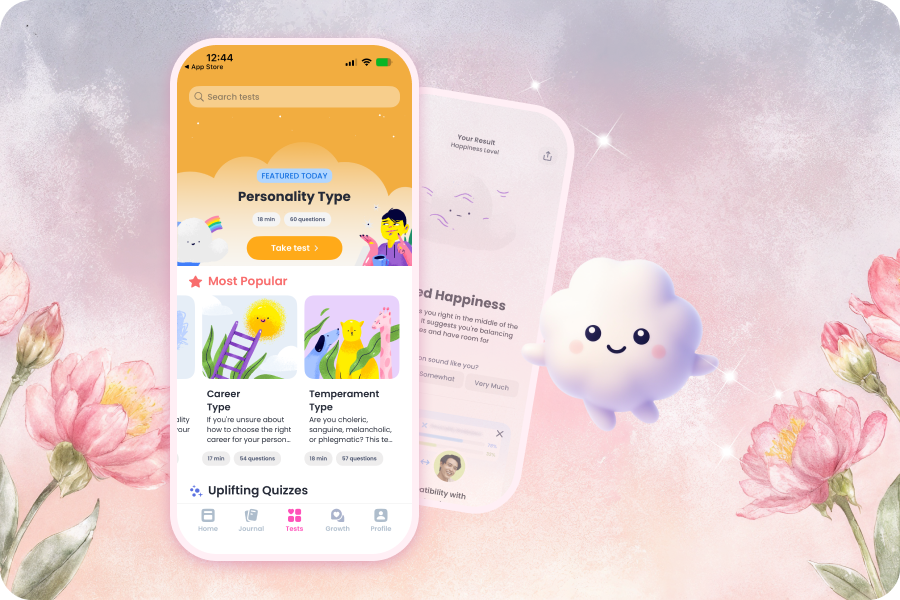
Breeze’s central feature is its collection of 43+ self-discovery quizzes, designed to encourage reflection on emotions, personality, relationships, coping patterns, and personal growth. The assessments are organized into four broad categories.
- Uplifting quizzes focus on light, engaging topics such as love language, mental age, personality archetype, emotional intelligence, and personal strengths.
- Personal growth quizzes explore users’ Jungian archetypes, charisma level, empathy, and masculine and feminine traits.
- Relationship assessments examine topics including attachment style, love languages, gaslighting check, and narcissistic relationship dynamics.
- Explore-yourself quizzes encourage broader self-reflection through topics such as focus skills, toxic traits, inner child archetype, manipulative tendencies, body image, etc.
Before starting any test, Breeze explains how long each test will take and the benefits of taking it. Afterward, the user receives the result along with personalized tips.
Journaling
Breeze’s guided journaling feature helps users reflect without facing an empty page. Prompts are organized around three needs most of us face regularly in day-to-day life:
- Foster gratitude by noticing positive experiences, support, progress, or meaningful moments.
- Calm anxiety by identifying distressing thoughts and objectively assessing their probability and potential impact.
- Release worry by putting repetitive concerns into words and separating controllable from uncontrollable factors.
These short prompts usually consist of 2-3 questions, which makes them more approachable than open-ended journaling when emotional energy is limited.
However, for those who just need to “pour it out,” Breeze Wellbeing has a freewriting opportunity that functions as a traditional diary. Write whatever you need: plans for the day, what you felt, venting, or quotes.
Mood Tracker and Analytics
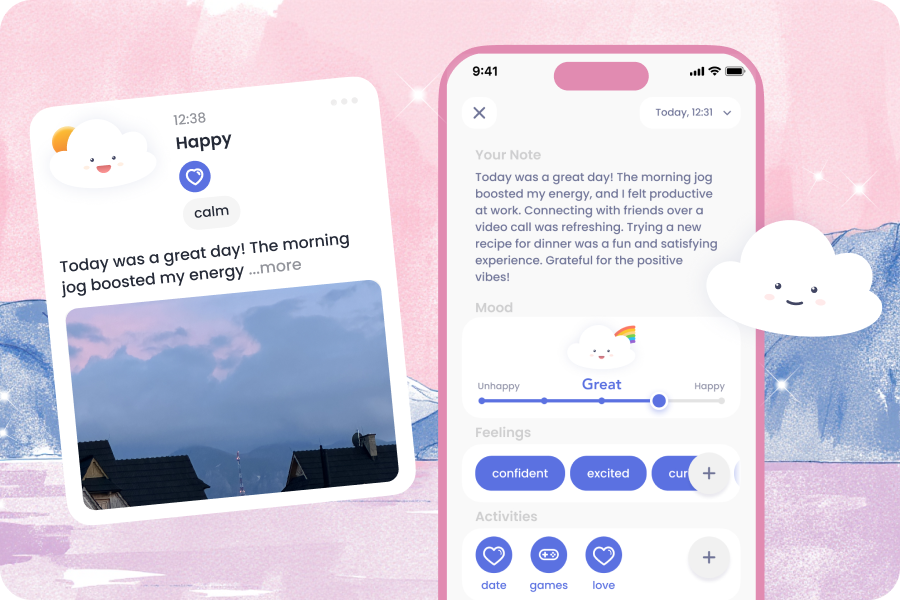
The mood tracker in the Breeze app is also multifaceted:
- Users record how they feel on a scale from unhappy to happy.
- Each entry can be expanded with the prevalent emotions (the list is huge, and feelings are customizable).
- Users can also note relevant activities and circumstances, i.e., what they were up to on that day.
- A photo can be added to preserve the setting or atmosphere surrounding the entry.
The analytics section summarizes the average mood across the week, month, or year. It also analyzes which activities led to more joy and which made you feel down.
By tracking mood, users learn which activities trigger what emotions. This helps prepare for events that are emotionally draining and to appreciate the moments when something brings you joy.
Mindfulness Games
Breeze includes brief interactive games intended to ground users and slow the pacing established by “cortisol lifestyle” and overstimulating social media.
Currently, three games are available:
- Flower Chain. The task here is to catch the flowers. It’s a repetitive visual task that slows down the pace and creates a mindfulness-like state.
- Calming Waters. The game where the user has to interact with different water textures. This game offers a soothing sensory experience for those who want to unwind or do something before bed.
- Breathing. This exercise guides users through slower, more deliberate breathing, which has been shown to calm the nervous system.
Important: These games aren’t treatments for trauma or other clinical conditions. They provide temporary sensory and emotional relief.
Affirmations
Breeze offers nearly 100 short affirmations focused on character, self-worth, emotional growth, resilience, personal evolution, and self-compassion.
Users can read them inside the app and share them on social media. One idea of how affirmations in the Breeze app can be used effectively:
- Choose one affirmation that feels personal. Preferably, choose the one that reflects your goals for self-discovery.
- Download it as a picture from the Breeze app.
- Save them as phone wallpaper.
Now, every time you’re going to pick up your phone, you’ll be reminded about how you truly are inside. This interrupts harsh self-talk that, with time, can transform into meaningful behavioral changes.
Insights
The Insights section serves as Breeze’s educational and community-focused content hub. It features articles across a wide range of topics, including:
- Nervous system
- Mental health
- Family & childhood
- Relationships
- Self-image
- Self-development
- Character studies
- Spirituality
- Quick take
The articles are written or reviewed by Breeze contributors and aim to present psychological and self-development concepts in clear, accessible language rather than technical terminology.
There is also a separate category for User Stories, where people share personal experiences and reflections. Readers can browse these stories, comment on them, and exchange ideas.
The way people discuss things is in no way clinical or 100% effective for everyone. But learning from the personal experiences of others instead of textbooks is more valuable.
Disclaimer: comments from other users should not be considered a substitute for qualified mental health advice.
Routines
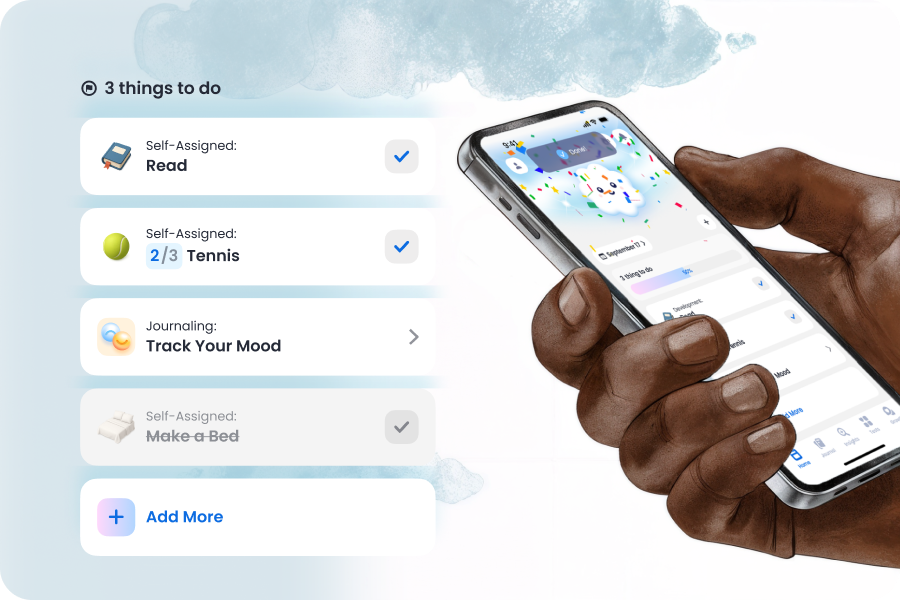
The Routines feature functions as an empathetic productivity and reminder tool built around small, manageable actions. It can have multiple purposes: self-care checklist, daily to-do list, reminder system, habit tracker, or a way to break larger goals into smaller, more approachable steps.
Users can also create morning or evening routines or organize everyday non-wellness tasks. The difference between Breeze Wellbeing’s routines and other productivity tools is that Breeze approaches tasks with more compassion for the user:
- Unfinished routines aren’t failures.
- Success doesn’t happen overnight.
- Giving at least minimal effort, but every day is a way to go.
Benefits and Limitations of the Breeze Wellbeing App
No self-care or mental well-being app is the right fit for everyone. The value of the Breeze Wellbeing app depends on your expectations and emotional needs. The table below provides a quick overview of the app’s strongest and weakest sides:
| Benefits | Limitations |
| Multiple self-reflection tools in one app. | Not every feature will suit every user. |
| Intuitive interface that is nice to look at. | Some features may feel too general if not personalized. |
| Available 24/7 independent self-care. | Does not replace professional mental healthcare. |
| Simple self-reflection and self-care during difficult periods or for beginners. | Regular use is needed to gain meaningful insights. |
| More affordable than ongoing therapy. | The full experience requires a paid subscription. |
| Responsive customer support, as reported by many reviewers. |
Now, let’s explore the pros and cons of the Breeze app in detail.
Breeze’s Pros
Breeze’s greatest strengths lie in its accessibility and convenience. The presented advantages depend on how the app is used, so they do not represent guaranteed outcomes:
- Clinically effective tools: Self-reflection through mood tracking, guided journaling, breathing exercises, and psychoeducational content draw on psychological concepts commonly used to support emotional awareness and well-being, clearly for different audiences.
- Intuitive design: Simple navigation and short, approachable activities make it easy to engage with the app, even during busy days.
- Accessible self-care: Many features are designed as small, manageable exercises, which may feel more achievable during periods with no motivation.
- More affordable than regular therapy: For many people, a subscription costs considerably less than ongoing therapy sessions. Breeze Wellbeing won’t replace professional mental healthcare, but it can support a person who experiences ongoing mental exhaustion.
- Large user community: Breeze reports that millions of people have used the app and that it has received thousands of ratings across app stores.
- Empathetic and validating tone: The app generally encourages curiosity and self-understanding instead of pushing for productivity or self-criticism.
- Responsive customer support: Many recent Breeze reviews describe prompt responses from the support team and successful assistance with account or subscription issues.
- Available anytime: Most features can be accessed whenever users have their phone, making it convenient for brief moments of reflection throughout the day.
Breeze’s Cons
Like most well-being apps, Breeze also has limitations that are worth considering before subscribing:
- Not every feature suits every user: Some people enjoy guided quizzes and affirmations, while others may prefer live therapy, meditation libraries, or more detailed symptom tracking that Breeze doesn’t offer yet.
- Simplicity may feel too general: Brief prompts and broad quiz results cannot fully capture complex personal histories or individual circumstances.
- Consistency matters: Most effective Breeze features, like mood tracking, routines, and journaling, are most effective when they are used consistently long-term because their effect is cumulative.
- The fullest experience requires a subscription: Although Breeze is free to download, access to some features requires a paid plan.
- Not a diagnostic or treatment tool: The app cannot provide individualized psychological diagnoses or treatment. Although Breeze’s tips are therapist-informed and based on personal results of every user, they cannot account for every personal, medical, or cultural factor.
Tip: Review the current pricing and cancellation terms before committing to a paid plan. Use a trial period or your first paid month as a test to see whether the app aligns with your needs.

Is Breeze Worth Trying?
Yes, trying the Breeze app is absolutely worth it for a few reasons:
- It’s versatile.
- It won’t harm.
- It’s free (considering the free version or a trial period).
- If you don’t, you’ll keep wondering whether it’s worth trying.
Breeze may be a good fit for people who want structured self-reflection but don’t know where to start or don’t have much time/energy to invest in self-care.
Breeze’s greatest value is not providing definitive answers about mental health but helping users pause and observe their own thoughts. Oftentimes, the answer to your inner questions is already in you. You just have to stop to find them.
*This is a collaborative post. For further information please refer to my disclosure page.
Related Posts:
Beautiful Living Room Ideas That Brighten Up Your Space

A beautiful living room isn’t about perfection. It’s about creating a home that feels balanced and truly lived in. You Read more
7 Small Daily Habits That Boost Your Mental Wellbeing

You don’t need to chase all those big solutions to feel good. A small pause here, a mindful choice there, Read more
What Are The Benefits of Yoga?

Yoga emanated from India over 5000 years ago. It focuses on flexibility, strength and breathing. Yoga practitioners do so by Read more
What Are Quick Ways to Enhance Metabolism Naturally?

Have you been staring at your coffee mug, wondering why it’s not doing its job anymore? I’ve been there - Read more