
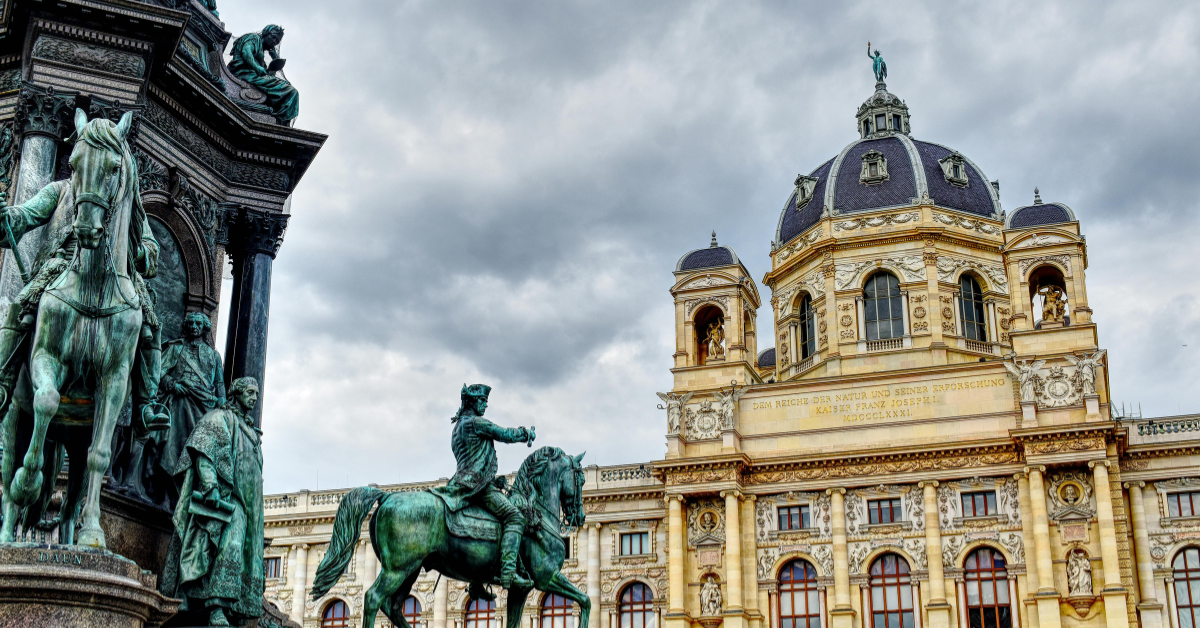
Gothic and Rococo Narratives: The Spire of St. Vitus and Viennese Coffeehouse Art
*Collaborative Post
In Prague, the skyline narrows before it rises. Rooftops cluster tightly, their angles folding into one another until the spire of St. Vitus emerges almost by accident. It does not dominate immediately. It appears in fragments — a dark vertical line between chimneys, a pointed outline against pale sky.
The air feels slightly denser near the castle walls. Stone steps hold shadow long after morning light has moved elsewhere. Sound travels upward along narrow lanes, then dissolves before reaching the top.
Nothing feels theatrical. It simply accumulates.
Where Stone Pulls the Eye Upward
The spire of St. Vitus does not rush skyward; it narrows into it. Carved details gather along its surface, intricate but not immediately legible. You look up and lose the sense of scale, the top dissolving into brightness.
Later, the rhythm extends south along routes like the Vienna to Prague train, where fields stretch in muted repetition before gathering again into clustered towns. The transition feels incremental rather than symbolic.
The cathedral’s verticality lingers even when the landscape flattens. A distant tree line aligns faintly with memory of carved stone. The sensation of upward pull persists beneath horizontal travel.

Rooms That Refuse to Empty
In Vienna, space behaves differently. Coffeehouses open outward rather than upward. High ceilings hold warmth. Marble tabletops reflect muted light. The atmosphere feels layered — conversation, newspaper rustle, porcelain resting gently against saucer.
Journeys threading the region often trace lines like the train from Prague to Vienna, where plains soften and river valleys gather in subdued curves. Even there, the shift feels gradual.
In the café, art does not hang dramatically; it settles into walls already heavy with time. The room does not insist on attention. It contains it.

Between Spire and Ceiling
St. Vitus compresses focus into vertical ascent. Viennese coffeehouses disperse it across horizontal space. One directs the gaze upward. The other allows it to wander.
Yet both rely on repetition — arch after arch, table after table. The rhythm holds steady. Neither demands explanation.
Light shifts differently in each place, though both absorb it quietly.
The Line That Continues Without Contrast
Later, recollection softens distinction. The dark silhouette of the spire aligns faintly with the curved ceiling of a café room. Rail journeys between Prague and Vienna blur into steady passage beneath clouded sky.
What remains is not opposition between Gothic stone and Rococo ornament, but continuity of atmosphere. Vertical line meeting horizontal room. Carved façade meeting polished surface.
And somewhere between pointed tower and café murmur, the movement continues quietly — not divided by border or style — simply unfolding beneath the same Central European light.
Where Echo Rises and Settles Again
Inside the cathedral, sound does not disappear; it ascends. A footstep lands on stone and seems to climb with the air before thinning into vaulted space. In Vienna’s coffeehouses, sound behaves differently. It remains at table height — the quiet slide of a chair, the low exchange of voices, the faint clink of porcelain. Neither silence nor noise dominates; both environments absorb what passes through them.
Over time, the difference feels less architectural and more atmospheric. Echo lifts. Murmur circulates. Each space holds sound without intensifying it.
The Corridor That Softens Edges
Between Prague and Vienna stretches a landscape of fields and small towns that rarely insists on attention. Platforms appear briefly. Hills gather and recede. The horizon remains wide enough to dilute contrast into tone.
Later, memory merges spire and ceiling into a single vertical and horizontal impression — height narrowing into sky, rooms widening beneath chandeliers. The journey between them dissolves into steady movement. And somewhere along that quiet corridor, the rhythm continues without declaration, carried forward across stone, plaster, and open plain alike.
*This is a collaborative post. For further information please refer to my disclosure page.
Related Posts:
11 Must-Visit Resorts in Myrtle Beach, South Carolina
For those seeking vacation destinations, Myrtle Beach, South Carolina, offers everything a beach enthusiast desires—sunshine, waves, and entertainment, all in Read more
How to Enjoy Las Vegas

What happens in Vegas, stays in Vegas. That’s the old saying and millions of adult visitors make a trip to Read more
Update Your Medicine Bag with General Care Medicines When Traveling

Taking proper care of your health while traveling is crucial for having an enjoyable trip. Whether you're embarking on a Read more
Why Lake Lanier Is a Favorite Destination for Relaxing Escapes
Nestled in the foothills of the Blue Ridge Mountains, Lake Lanier has become one of Georgia's most cherished getaway destinations. Read more