
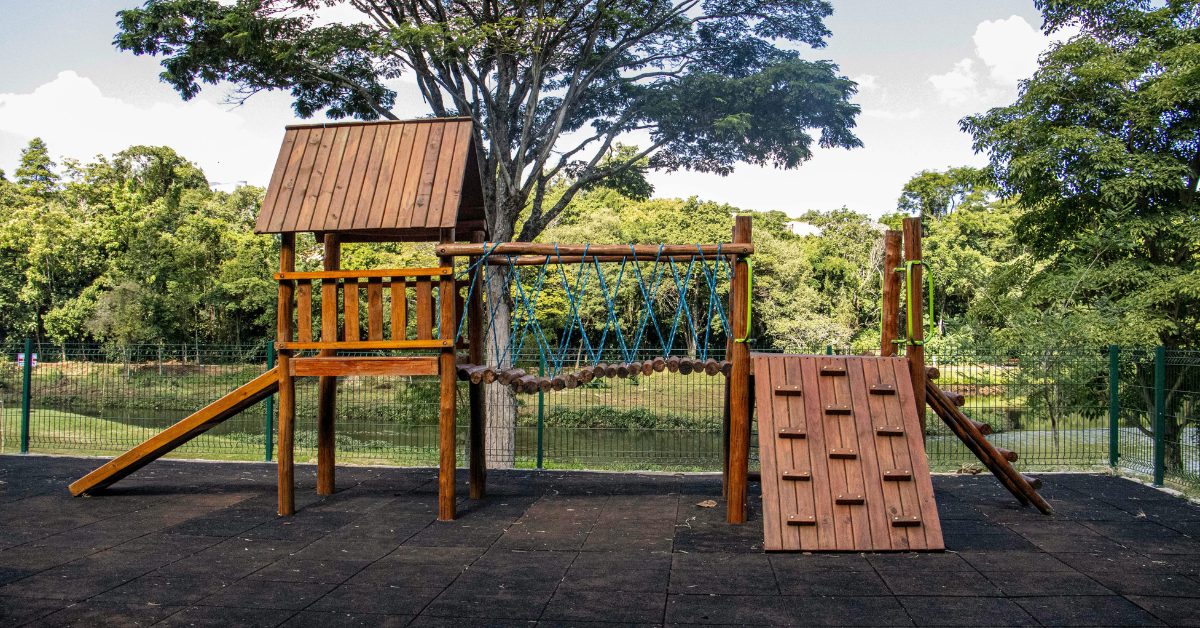
How Much Room Does Your Backyard Need for a Jungle Gym?
*Collaborative Post
Most parents measure for the climbing frame and stop there. The frame is the easy part. What catches people out is the empty ground around it, because a child mid-leap off the monkey bars travels further than you’d guess, and that landing area is where the real measuring happens.
A sensible starting figure is to leave at least 1.8 metres (roughly six feet) of clear ground on every side of the structure. So a compact play centre that reads as 3 by 3 metres on the spec sheet wants a patch closer to 6 by 6 metres once you add that buffer. Larger setups with a slide and a swing arm attached can stretch past 7 metres in one direction. Measure the full zone rather than the silhouette of the equipment, and the rest of the planning gets a lot simpler.
The clearance zone does the quiet work
The buffer exists because kids do not use play equipment politely. They jump off platforms, swing wide, run at the slide, and bail out sideways. If you compare the spec sheets across a few jungle gyms, you’ll see manufacturers list two numbers: the unit footprint and a recommended safe area. The second number is the one that should drive where the structure goes.
A slide needs extra room at the bottom for the run-off, often a metre or more of clear ground past the exit. A swing needs clearance front and back equal to roughly twice the height of the swing beam, since a child in full motion covers more arc than the seat suggests at rest. Plan around the swing and you’ve usually planned around everything else.
Ground surface counts as much as square metres
Square metres get the attention, but what sits under the frame decides how a fall plays out. Grass looks soft and compacts into something closer to hard clay after a wet winter and a summer of foot traffic. Bark chips, rubber mulch, and engineered wood fibre all absorb impact far better, and the depth matters: around 25 to 30 centimetres of loose-fill material under and around the equipment is the range most safety guidance points to for taller frames.
The taller the highest platform, the more this matters. A structure with a 1.5 metre deck has a longer fall height than a toddler frame, so the surface below it has more work to do. If your only flat spot is a slab of patio or compacted earth, factor the cost of a soft surface into the project rather than treating it as optional.
Working with a smaller yard
A modest backyard does not rule out a proper climbing structure. It changes which one fits. Vertical designs that build upward instead of sprawling sideways give you climbing, a slide, and a cubby in a footprint a wider frame would never manage. Tucking the unit into a corner can also reclaim usable space, as long as you keep that 1.8 metre buffer on the two open sides and avoid backing a swing into a fence.
Be honest about the shape of your yard too. A long narrow strip suits a frame with a slide running down its length better than a square play tower that wants room on all sides. Pace the space out with a tape measure and some stakes before you order anything, because a structure that looks fine in a product photo can swallow a small lawn whole.
Where you place it changes how often it gets used
Position is not only a safety question. A jungle gym baking in full afternoon sun gets abandoned by January, when metal fittings heat up and plastic slides turn uncomfortable. A spot that catches morning light and falls into shade by midday tends to get played on for far longer stretches. If you have a tree that throws afternoon shade, building near it (though not under heavy branches that drop limbs) is worth the slightly awkward layout.
Sightlines deserve a thought as well. Younger children climb more confidently when a parent is visible, and you’ll supervise more easily if the frame sits where you can see it from the kitchen window or the back deck. Hiding it down the side of the house keeps the lawn tidy and tends to keep the equipment unused.
A couple of questions worth settling early
Can you put a frame on a slope? A gentle grade can be levelled with a bit of digging or a low retaining edge, but anything steep enough to roll a ball down quickly is a problem. Climbing structures are designed for level ground, and a tilted base undermines the stability the whole thing relies on.
How close to a fence is too close? Keep the structure far enough back that a swing arc or slide exit never sends a child into the boards, and remember that a frame doubles as a ladder for anyone curious about what’s on the other side. Most families find a metre of separation from a boundary fence is the minimum that feels right, more if there’s a swing in the mix.
Measure twice, stake it out, and walk the space the way a six-year-old would before you commit. The yard that handles the equipment well today is the one that still works when the kids are bigger, faster, and bringing friends home.
*This is a collaborative post. For further information please refer to my disclosure page.
Related Posts:
How to Create Spooky Halloween Costumes on a Budget

Halloween is right around the corner and it is one of my favourite times of year. That autumnal feel, the Read more
Natural Ways to Keep Your Skin Looking Young

Our skin is not only our body's largest organ, but it also serves as a reflection of our wellness. Amidst Read more
Get The Joseph Gordon-Levitt Style

*Collaborative Post Joseph Gordon-Levitt (or as some affectionately call him, JGL) is a long-standing star. Starting his career young, he entertained Read more
10 Ways I Have Adapted My (small) Garden to Cope With Climate Change

Climate change, whether you want to hear it or not, is here. Each year we are seeing more extreme weathers, Read more